
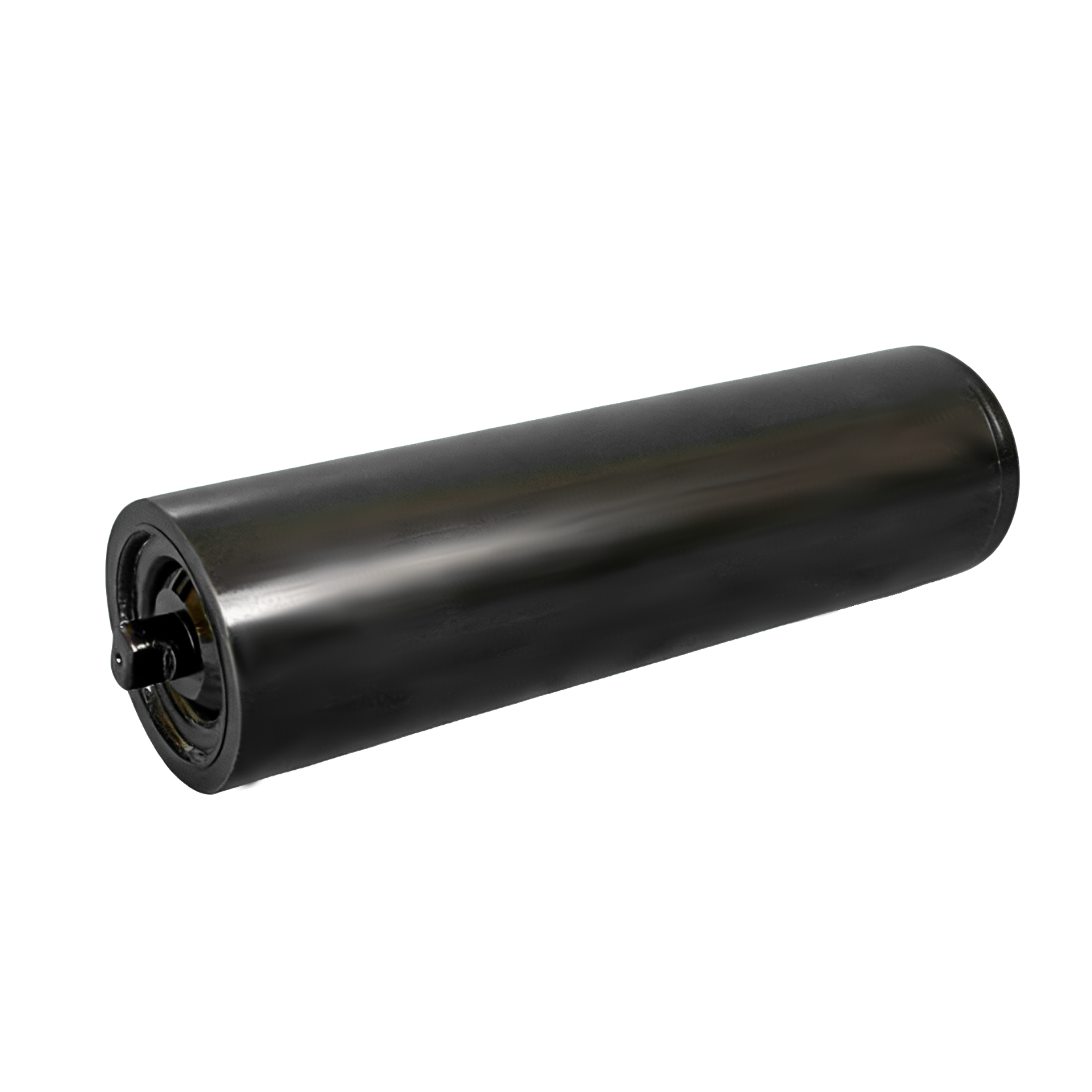
Start with the belt position
A roller should be specified for the job it performs. Carrying rollers support the loaded belt along the conveying run; return rollers support the belt on its return path. Impact rollers are used at loading points where falling material creates impact. These descriptions identify the duty, but do not establish a load rating or prove that a roller will fit an existing frame.
Compare the three duties
- Carrying rollers: describe the conveyed material, belt width, belt speed and loading. Include the arrangement of the roller set on the frame.
- Return rollers: identify the return-belt position and required mounting span. Do not copy the carrying-roller length without checking the return frame.
- Impact rollers: show the loading position and describe the falling material, loading pattern and impact conditions. Ask for application review rather than choosing by appearance alone.
Read the dimensional reference as a starting point
In the Sunwarm carrying-roller reference, the D 89–108 mm group lists shaft diameter d 20–30 mm, length L2 200–800 mm and tube wall thickness S 3–3.5 mm. These are selection ranges. They do not mean that every combination is available, or that the same ranges apply to return and impact rollers. Use the notation and length definition in the relevant manual. Show tube length, overall length and mounting length separately on the drawing.
Check replacement parts against the frame
For a replacement, send a dimensioned drawing and clear photographs of the existing roller, shaft ends and frame seats. Confirm shaft-end machining, mounting dimensions, bearing reference and sealing requirements. A similar outside diameter does not confirm interchangeability. If the old roller has failed, describe the observed damage and service conditions without assuming that a different roller type alone will solve the problem.
Make the inquiry specific enough to review
State the roller type, quantity for each size, operating conditions, destination and required delivery date. Mark any critical dimensions or agreed inspection requirements. Load capacity, speed and service suitability need an application-specific assessment. Use the roller inquiry checklist to prepare the drawing, then compare the revised Sunwarm selection manuals.